
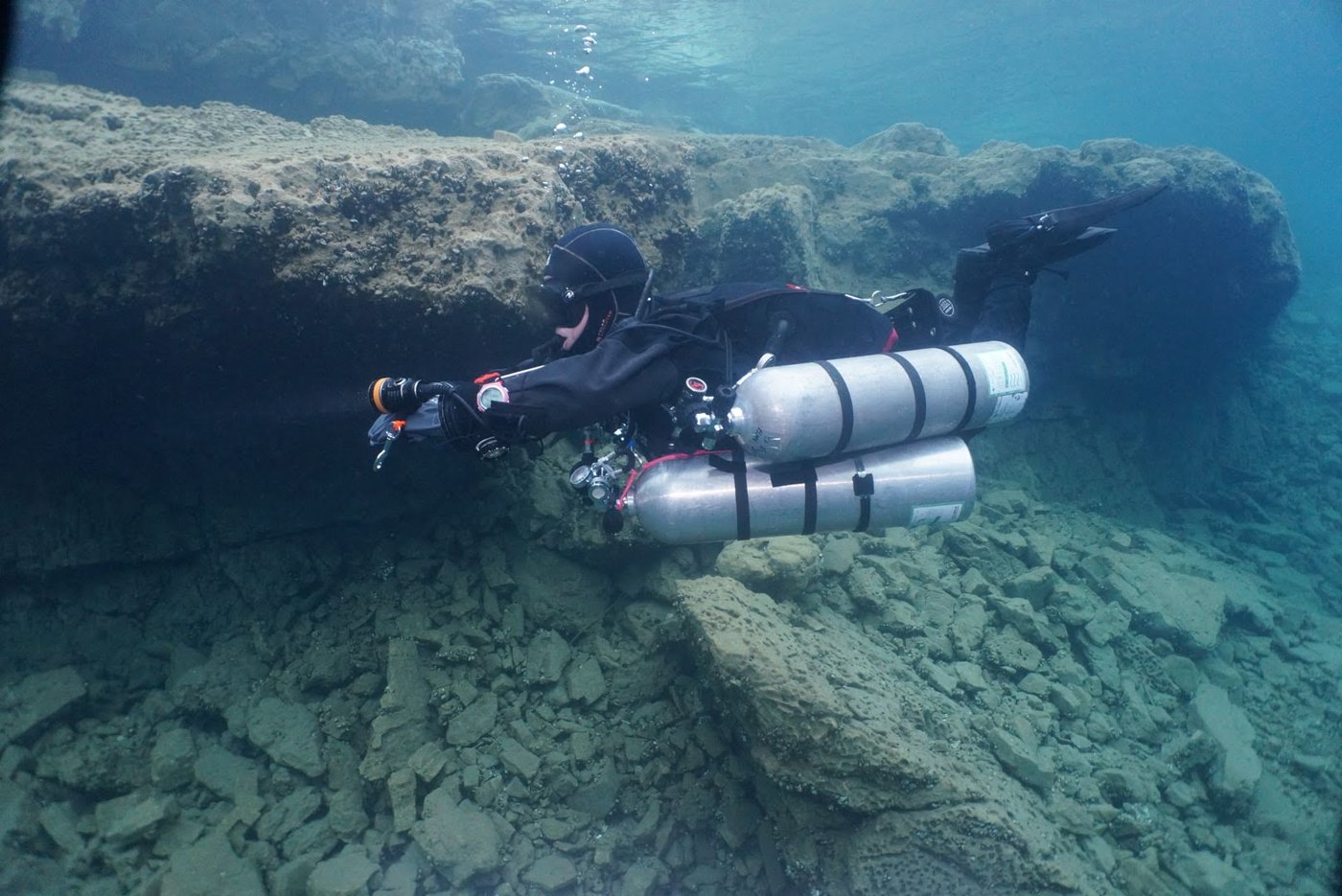
Yes, divers need to drink enough to stay properly hydrated to reduce the risk of decompression sickness and other health complications. As a result, divers might want to pee underwater. If you are diving in a wetsuit, you can just let it go. It doesn’t work for drysuit users, because they are wearing a sealed, waterproof shell with tight seals at the neck and wrists.
The good thing is, it’s way easier to hold it when you're staying dry. The bad thing is, sometimes it might become a problem.
That's when a p-valve enters the game.
In simple terms, a p-valve is a device for a drysuit diver to urinate without getting out of the suit. A valve is installed through the drysuit and connected to a catheter system worn underneath. For women, devices such as the She-P provide a way to connect to that system.
It may sound like an unnecessary complication until you're thousands of metres into a cave, decompressing in blue water, or spending hours in a drysuit before jumping under the ice. Then being able to urinate without removing your drysuit becomes less of a luxury and more of a practical part of dive planning.
I've been using She-P for several years, and it has become a normal part of my equipment configuration.
Until one day... I was in Mexico, doing my advanced cave course. The plan involved a long decompression dive in sidemount configuration with multiple cylinders. Unfortunately, something personal got in the way of my usual solution, and I had no good alternatives. I decided to try what some veterans had used. Diaper!
I stopped at the nearest supermarket and bought a pack of XS adult nappies. I had never purchased them before and was surprised by how many options were available. The diaper sat comfortably under my regular underwear, and everything appeared streamlined and secure.
I congratulated myself on solving the problem. Too early…
During the pre-dive equipment/buddy check, something felt slightly off. Looking back, that's probably the most important lesson of the entire story. If something feels unusual before a dive, you should stop and figure out why. I didn't. I'd also completely forgotten I was even wearing a diaper.
Within minutes of entering the cave, my trim and buoyancy fell apart. My feet and hips floated upward; every few seconds I was fighting to get back into position. It looked like the kind of problem you'd expect from someone wearing a drysuit for the first time… and would never forgive in a cave diver.
My instructor was baffled (I'm trying to use the most polite word). He'd watched me progress through multiple courses over the years; he'd seen me make plenty of mistakes and questionable decisions, but never struggle like this.
My buddy looked equally confused. So was I.
By the time we turned the dive, I finally connected the dots. The diaper was the only new piece in my dive setup.
If you've never worn a drysuit, none of the above probably makes sense yet. So let me back up.
Unlike a wetsuit, a drysuit stays completely dry inside. Divers wear insulating undergarments beneath it, and during the dive they add small amounts of gas into the suit to prevent the insulation from being compressed by water pressure. That gas keeps you warm. It also moves.
Picture a bubble inside a sealed balloon. Wherever the highest point goes, the bubble wants to follow. If gas migrates into your legs or feet, your lower body becomes more buoyant than the rest of you. The diver often has to reposition their body so the trapped gas can travel toward the exhaust valve before it can escape. If that doesn't happen, the result can range from awkward trim to a full feet-first ascent.
In other words, drysuit diving is partly about managing where that gas lives. And this is where my improvised solution created a problem I hadn't anticipated.
Years of diving in the same drysuit and configuration had never produced anything like this. The diaper was the only change to the setup.
Gas was trapped around the crotch, where getting it out of the lower part of a drysuit is already difficult. Rather than having one manageable air pocket I could work toward my dump valve, I seemed to have a second pocket that refused to clear. As a result, my hips and feet kept floating, over and over, for the entire dive.
Of course, your experience may be completely different, and a lot of divers use diapers without ever running into this problem. It happened to me, and it's worth knowing it can happen to someone else.
The message was simple, as usual: never use untested equipment on a complex project.
Some lessons are more expensive than others. Mine ended up with a horrible dive, a return trip to Mexico, and, eventually, a successful course completion.