
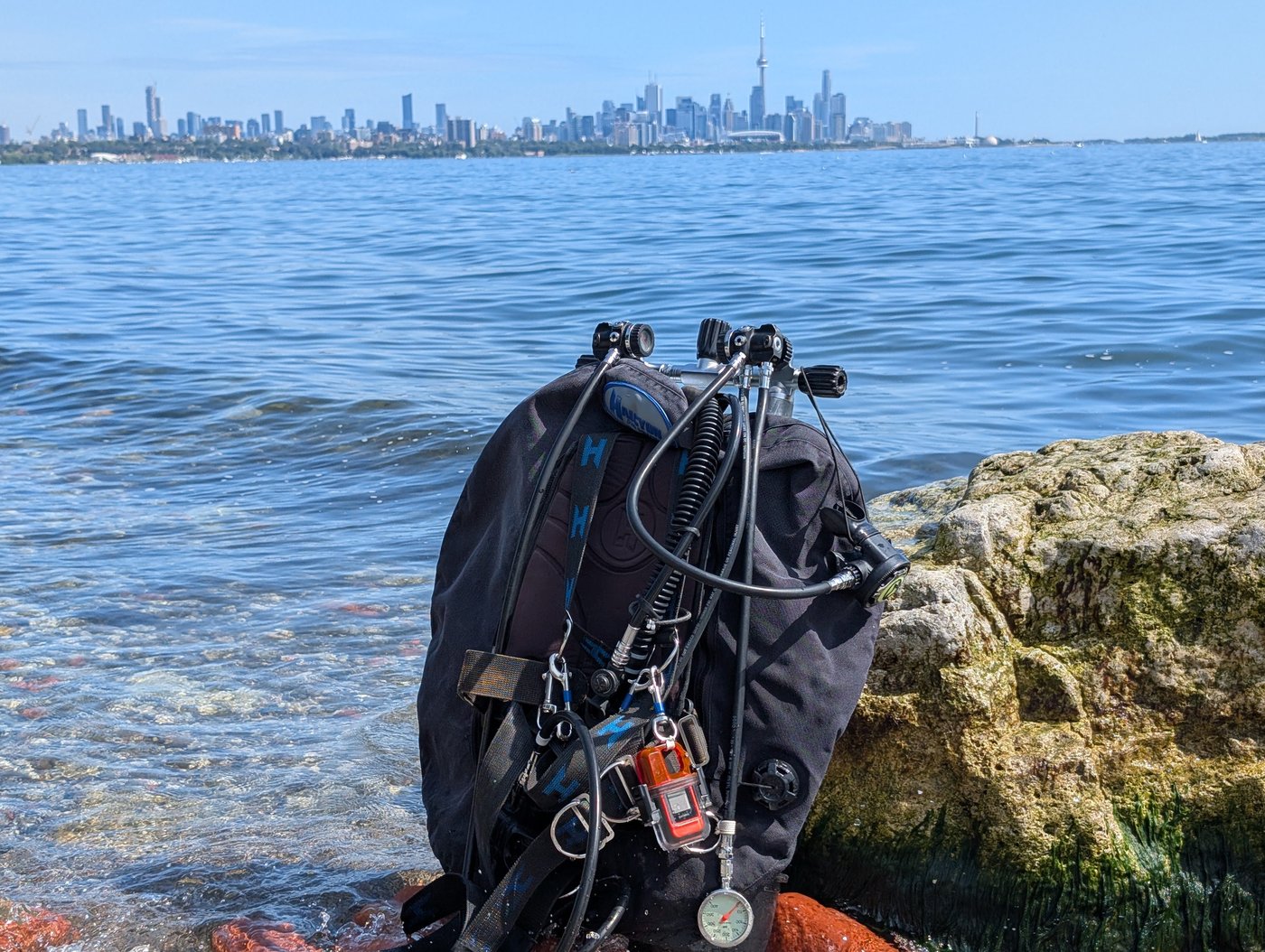
The way the two work together is straightforward. Garmin Response continues to coordinate with local search and rescue and communicate with the person in distress through the inReach. DAN adds its dive-medicine knowledge and expertise to the dive-related emergency response.
A user adds their DAN member ID to their inReach account ahead of time. If an SOS is triggered, Garmin Response (the 24/7 emergency coordination centre) can bring DAN's specialists into the response.
It's also worth clarifying how the two memberships actually work together, because they don't merge into a single plan. A DAN membership does not include or activate an inReach satellite subscription, and owning an inReach with an active satellite plan does not grant DAN membership. They remain two separate products, sold and paid for independently.
The collaboration simply lets someone who already has both active accounts connect them. Without a current DAN membership, an inReach SOS still works exactly as it always has, just without DAN's dive-medicine team looped in.
One way to understand the potential value of the partnership is to look at a real case that happened before this collaboration existed.
In 2024, Eric and Nicole DeHaven were diving off Caye Caulker in Belize when Nicole began experiencing chest tightness and numbness during the dive, nearly two hours from shore. By the time she was back on the boat, she was disoriented and had numbness in one arm.
The boat had no radio or emergency communication equipment.
Eric used his inReach to communicate with the dive shop and then triggered an SOS. Garmin Response coordinated a faster boat, transportation to a local clinic and an evacuation. Nicole was eventually airlifted twice, first within Belize and then to Florida.
The case shows what an inReach can already do when conventional communications aren't available. It also illustrates where the DAN collaboration could add another layer: dive-medicine expertise alongside the emergency-response process.
The important word is “could”. The DeHaven incident happened before this collaboration, so we cannot know whether DAN's involvement would have changed the outcome or response time.
Satellite communication naturally brings to mind remote diving, liveaboards and places where there may be no cell service. But let's look at it from another perspective and take shore diving in Ontario as an example.
Many Great Lakes dive sites are relatively close to roads, parking lots and populated areas. Cell coverage may be perfectly fine there. Does that mean you will be able to make an emergency call quickly when you need to? Not necessarily.
Imagine a two-person team on a shore dive. One diver surfaces in distress. The buddy gets them to shore and keeps them supported at the surface. The emergency plan may say that someone on shore should call 911, but that may be difficult or even impossible at the moment. Why? Because on a quieter stretch of Great Lakes shoreline, there may not be a bystander around to make that call.
In reality, most divers leave their phone in the car while diving. If the team surfaces 100 metres away from shore, the buddy may need to tow the distressed diver that distance while performing first aid. They may also have to leave the person unattended, remove their own gear, run to the parking lot, open the car, determine the exact location, call 911 and explain the situation.
A satellite communicator reduces that dependency and could help start the emergency response sooner, even before the dive team reaches shore. At the same time, inReach isn't a replacement for a phone. If there is a working phone close enough and someone can make a call to 911, use the phone.
The Ontario Underwater Council Emergency Action Plan (EAP) guidance addresses this directly. Its specific Emergency Communication Plan is built around a simple idea: someone has to know what to communicate, where to communicate it, and who is responsible for doing it.
It recommends determining how communication will work at the particular site and assigning an EMS communicator as a specific role, separate from the people providing first aid, oxygen or managing the rescue.
The OUC also recommends preparing a phone script in advance with the critical information: exact location and access route, nature of the emergency, number of patients, consciousness and breathing status, signs and symptoms, treatment provided, hazards and a callback number.
That's where an inReach becomes another tool within the EAP and the pre-dive check. It shouldn't be something only its owner knows how to operate. The team should know who is carrying it, where it is, how to remove the device from its case and how to activate the SOS.
The device may belong to one diver, but the emergency procedure belongs to the whole team. Don't wait until an emergency to figure it out.
All inReach Mini series devices have an IPX7 water-resistance rating, meaning they can withstand accidental submersion in up to 1 metre of water for 30 minutes. The dedicated dive case is rated to depths of up to 100 metres.
For anyone wondering how to carry and use the device while diving, here's my own setup.
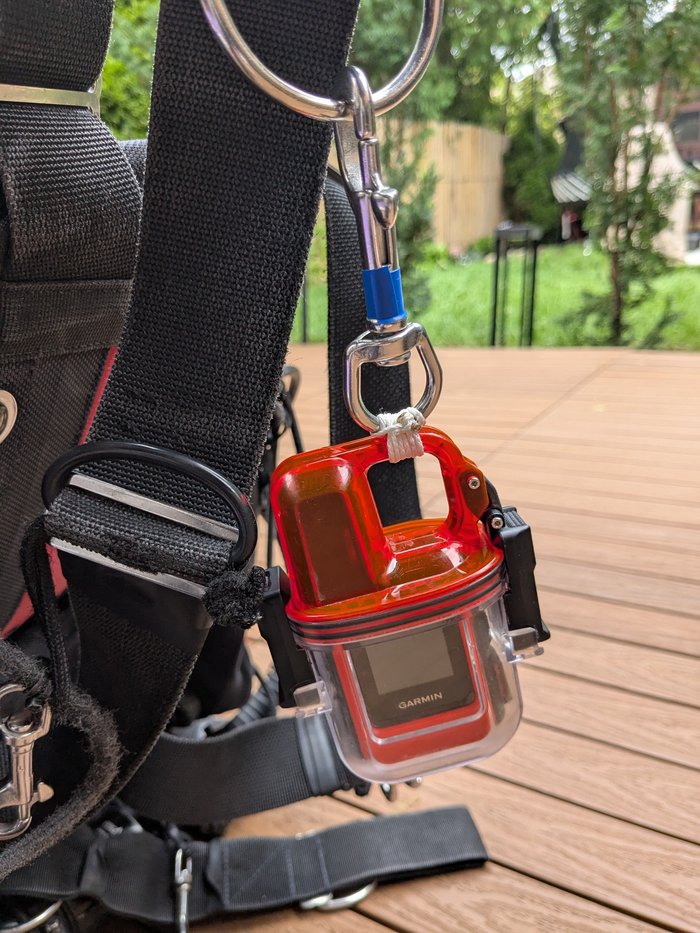
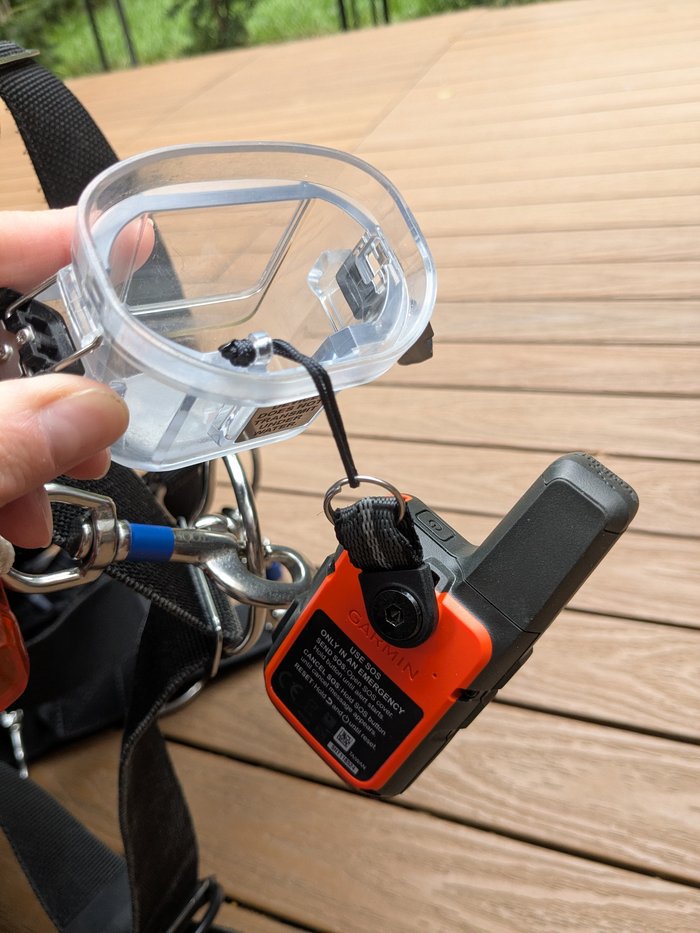
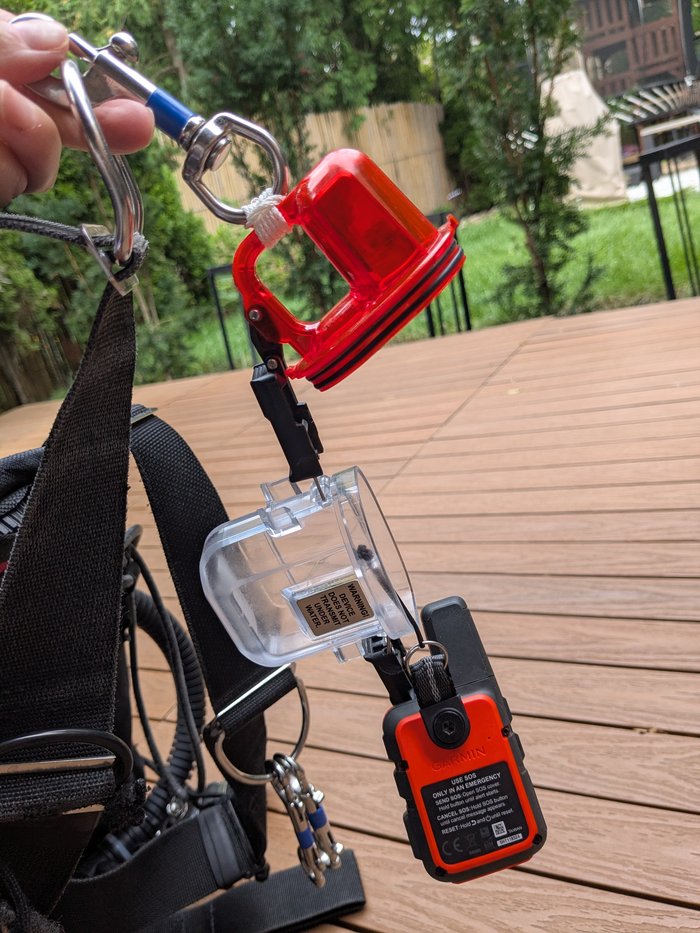
During the dive, my inReach sits in a dive case in my drysuit pocket, clipped to a D-ring and kept out of the way. At the surface, if something goes wrong, I take the encased inReach out of the pocket and clip it to the D-ring on my harness. That puts the device within reach and allows me to operate it with one hand while managing a person in distress.
The device itself is secured to the case with a lanyard, while the case is clipped to my harness. That gives me two points of retention and helps prevent me from dropping it.
To activate the SOS, the protective case needs to be opened and the SOS button cover removed. On inReach Mini devices, an SOS can be triggered even when the device is powered off, provided it has sufficient battery power. Pressing and holding the SOS button starts it, then a short countdown runs before the signal actually transmits.
Satellite communication also needs a clear path to the sky, and anything in the way can block it, including a wave. So being at the surface isn't always enough. You need to actually lift the device clear of the water, with an open view of the sky, to be able to send a message, coordinate or trigger an SOS.
So where does that leave us? An inReach doesn't replace the phone, the emergency plan or the buddy who knows what to do. The inReach adds another way to start the emergency response, potentially before a team makes it back to shore. The DAN/Garmin collaboration brings dive-medicine expertise into that response.
For a remote dive, that could mean calling for help from far offshore. For a familiar local site, you can get the call started before you reach the parking lot.